

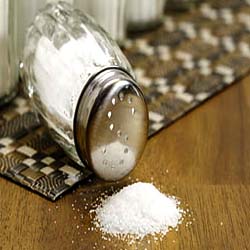
On a quiet evening, you season your dinner with a pinch of sea salt. It feels like a healthy choice—natural, mineral-rich, drawn straight from the ocean. But mounting scientific evidence suggests that this everyday habit may also deliver something far less natural: microplastics.
Microplastics are plastic fragments smaller than five millimeters, created when larger plastic waste breaks down under sunlight, waves, and time. Once released, they spread everywhere—through oceans, rivers, air, and food systems. Over the past decade, scientists have confirmed that these particles have also entered one of the most basic staples of the human diet: salt.
Multiple peer-reviewed studies have documented microplastic contamination in commercial sea salts worldwide, showing that this is not an isolated or regional issue (Yang et al., 2015; Kim et al., 2018).
What the Research Reveals
A recent investigation by Galaxy Enterprises analyzed fifteen sea salt products, including traditional and commercially branded varieties. The results mirrored global scientific findings.
Some samples contained hundreds of microplastic particles per kilogram of salt. Traditional sea salts ranged from 106 to 3,753 particles per kilogram, while branded salts ranged from 26 to 867 particles per kilogram. Statistical analysis showed no meaningful difference between the two groups (p > 0.540), indicating that branding and price do not guarantee lower contamination.
Comparable concentrations have been reported across multiple countries. Studies in China, Spain, Italy, and Turkey consistently show that sea salts contain more microplastics than rock or lake salts (Iñiguez et al., 2017; Özçifçi et al., 2023).
What These Particles Look Like—and Why That Matters
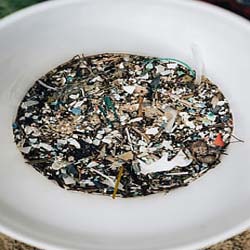
Under microscopic examination, most particles appear as thin fibers, ranging from 17 micrometers to nearly 5 millimeters in length. Chemical analysis identifies polyethylene terephthalate (PET) and polypropylene (PP) as the dominant polymers.
These materials are the same plastics used in beverage bottles, food packaging, and synthetic textiles. Their presence in salt reflects widespread marine pollution and has been repeatedly confirmed in global surveys (Kim et al., 2018).
A Daily Exposure Pathway
Salt is not consumed occasionally—it is consumed every day. Although salt is not the single largest dietary source of microplastics, its constant intake makes it a reliable and unavoidable exposure route over a lifetime (Wright & Kelly, 2017).
As microplastics continue to fragment into nanoplastics, their ability to cross biological barriers increases. Researchers are increasingly concerned that these particles do not simply pass through the digestive system.
In 2022, scientists confirmed the presence of plastic particles in human blood, demonstrating that ingested microplastics can enter internal circulation (Leslie et al., 2022).
What Science Says About Health Risks
Microplastics are not inert. They can absorb heavy metals, pesticides, and persistent organic pollutants, acting as vectors that transport environmental toxins into living organisms (Smith et al., 2018).
Laboratory and environmental health studies link chronic microplastic exposure to oxidative stress, inflammation, immune disruption, and hormonal interference. While large-scale human data are still emerging, current evidence raises serious concerns (Prata et al., 2020; Vethaak & Legler, 2021).
Animal studies further suggest that plastics can accumulate in organs such as the liver and brain and may produce developmental and generational effects, particularly when exposure occurs during pregnancy.
How Microplastics End Up in Sea Salt
The pathway is direct. Plastic waste enters oceans through rivers, coastal runoff, and improper disposal. Sunlight and mechanical forces break it into microplastics. During salt harvesting, when seawater evaporates, these particles become trapped in forming salt crystals.
Airborne microplastics add another layer of contamination, settling into salt pans during processing. Even packaging and handling equipment can contribute additional fibers.
Because sea salt is produced directly from seawater, it consistently reflects the level of marine pollution present at its source.
Safer Choices for Consumers
Research shows that rock salts and lake salts, particularly those mined from ancient underground deposits, generally contain significantly fewer microplastics than sea salts (Yang et al., 2015; Özçifçi et al., 2023).
Consumers can reduce exposure by:
-
Choosing mined or ancient-deposit salts
-
Reducing plastic food packaging
-
Using glass or metal storage containers
-
Limiting ultra-processed foods
These steps, while simple, can substantially reduce long-term intake.
A Call for Industry and Policy Action
Scientists agree that responsibility cannot rest solely on consumers. Salt producers have access to filtration and separation technologies that could remove a large proportion of microplastics during production.
Public health researchers have emphasized that microplastics represent a systemic pollution problem, requiring regulatory oversight similar to other food contaminants (Vethaak & Legler, 2021).
Clear labeling, routine testing, and stronger environmental protections are increasingly viewed as necessary steps.
A Wake-Up Call from the Ocean
Sea salt has long symbolized purity. Today, it also tells a story about the state of our oceans—and the unintended ways pollution returns to us.
Microplastics in salt are not a distant environmental concern. They are already on our tables. Understanding this reality allows consumers, industries, and policymakers to make informed choices before contamination becomes even more widespread.
The next time you reach for the salt shaker, the question may no longer be how much salt you’re using—but what else comes with it.
References
-
Yang, D., Shi, H., Li, L., Li, J., Jabeen, K., & Kolandhasamy, P. (2015). Microplastic pollution in table salts from China. Environmental Science & Technology, 49(22), 13622–13627.
https://pubs.acs.org/doi/10.1021/acs.est.5b03163 -
Özçifçi, A., Aydin, F., & Kılıç, O. (2023). Occurrence of microplastics in sea salt and rock salt marketed in Turkey. Marine Pollution Bulletin, 187, 114566.
https://doi.org/10.1016/j.marpolbul.2023.114566 -
Kim, J. S., Lee, H. J., Kim, S. K., & Kim, H. J. (2018). Global pattern of microplastics (MPs) in commercial food-grade salts: Sea salt as an indicator of seawater MP pollution. Environmental Science & Technology, 52(21), 12819–12828.
https://pubs.acs.org/doi/10.1021/acs.est.8b04180 -
Iñiguez, M. E., Conesa, J. A., & Fullana, A. (2017). Microplastics in Spanish table salt. Scientific Reports, 7, 8620.
https://www.nature.com/articles/s41598-017-09128-x -
Leslie, H. A., et al. (2022). Discovery and quantification of plastic particle pollution in human blood. Environment International, 163, 107199.
https://www.sciencedirect.com/science/article/pii/S0160412022001258?via%3Dihub -
Prata, J. C., da Costa, J. P., Lopes, I., Duarte, A. C., & Rocha-Santos, T. (2020). Environmental exposure to microplastics: An overview on possible human health effects. Science of the Total Environment, 702, 134455.
https://linkinghub.elsevier.com/retrieve/pii/S0048969719344468 -
Smith, M., Love, D. C., Rochman, C. M., & Neff, R. A. (2018). Microplastics in seafood and the implications for human health. Current Environmental Health Reports, 5(3), 375–386. https://link.springer.com/article/10.1007/s40572-018-0206-z
- Wright, S. L., & Kelly, F. J. (2017). Plastic and human health: A micro issue? Environmental Science & Technology, 51(12), 6634–6647.
https://pubs.acs.org/doi/10.1021/acs.est.7b00423 -
Vethaak, A. D., & Legler, J. (2021). Microplastics and human health. Science, 371(6530), 672–674.
https://www.science.org/doi/10.1126/science.abe5041