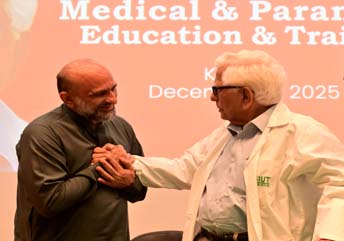
The SIUT and the Edhi Foundation sign a Memorandum of Understanding (MoU) to enhance cooperation in undergraduate technical and medical education, marking a major step toward expanding learning opportunities in Pakistan’s healthcare sector.
The initiative will be executed through the Sindh Institute of Medical Sciences (SIMS) — SIUT’s HEC-recognized degree-awarding institution.

The MoU was formally signed by Professor Dr. Adib Rizvi, Founder of SIUT, and Mr. Faisal Edhi, CEO of the Edhi Foundation. The partnership aims to strengthen academic development, promote modern clinical training, and equip students with advanced medical knowledge and emerging technologies.
Speaking at the signing ceremony, Dr. Adib Rizvi emphasized the deep humanitarian bond between the two institutions, recalling the legacy of the late Abdul Sattar Edhi. “Abdul Sattar Edhi was a great human being; he was a straight person,” Dr. Rizvi said, paying tribute to the iconic philanthropist whose life’s mission reflected compassion and service.
The Edhi Foundation has been a long-standing supporter of SIUT. In 2014, the organization contributed Rs. 100 million to modernize an operation theatre, now known as the Abdul Sattar and Bilquees Edhi Transplant OT Complex. Additionally, the Foundation provided eight ambulances and two loaders, which continue to transport critically ill patients free of cost.
On the occasion, Faisal Edhi reaffirmed the Foundation’s commitment to accessible education, stating, “We will bear all the additional expenses in the provision of education.” He added that the partnership reflects Edhi Foundation’s dedication to supporting institutions that serve the public without discrimination.

At a time when rising inflation has placed healthcare and education beyond the reach of many families, the collaboration between SIUT and the Edhi Foundation underscores a shared mission: making quality healthcare and medical education accessible to all. SIUT has upheld this philosophy for more than five decades, providing free, dignified, and high-standard medical care.
The newly signed MoU sets the stage for capacity building, skill development, and long-term progress in Pakistan’s health and education sectors, strengthening the pipeline of future medical professionals committed to public service.
Readers interested in the proceedings of the ceremony can watch the event here: https://www.facebook.com/share/v/1KD8os41Up/
Medical Technology Education at SIMS-SIUT (The Free-of-Cost Model)
The Sindh Institute of Medical Sciences (SIMS) serves as the educational powerhouse of SIUT, constituting the vital pillar of this expanded collaboration with the Edhi Foundation. Importantly, SIMS upholds SIUT’s foundational principle: providing comprehensive medical education that is notably free of any tuition cost upon a student’s acceptance.
This funding model, supported by the SIUT Trust, ensures that high-quality training is accessible to all eligible and underprivileged students, reflecting the ‘free with dignity’ philosophy.
I. Core Undergraduate Programs
SIMS primarily focuses on the Bachelor of Science (BS) in Medical Technology, a four-year, eight-semester degree program (often locally referred to as BTech in Medical Technology).
This curriculum is designed for rigor, integrating intensive academic instruction with extensive hands-on training within SIUT’s hospital setup, ensuring graduates are highly skilled and job-ready.
Specifically, the institution offers specializations in high-demand allied health fields, including:
-
Clinical Laboratory Sciences: Students train to perform complex diagnostic tests on bodily fluids and tissues, providing crucial data for disease detection, diagnosis, and treatment monitoring.
-
Diagnostic Radiology: Focuses on the use of advanced imaging technologies—like X-rays, CT scans, and MRI—to visualize and diagnose internal injuries and diseases.
-
Anesthesia and Critical Care Sciences: Professionals in this field assist anesthesiologists and manage patients’ critical life support functions before, during, and after surgical procedures or in Intensive Care Units (ICU).
-
Dialysis and Critical Care Sciences: Specializes in operating and managing dialysis equipment and providing intensive care support for patients with renal failure.
-
Operation Theater Sciences: Covers the management of the operating room environment, sterilization protocols, and assisting surgical teams during complex procedures.
-
Nuclear Medicine and Radiotherapy: Involves the specialized use of radioactive materials for both diagnostic imaging and targeted treatment of diseases, particularly cancers.
-
Respiratory Therapy and Critical Care Sciences: Focuses on assessing, treating, and managing patients with cardiopulmonary (heart and lung) disorders.
Furthermore, the institution provides:
-
BS in Nursing (4 Years): A comprehensive Baccalaureate program dedicated primarily to female students, cultivating both clinical expertise and compassionate care.
-
Diploma Programs (2 Years): Shorter, specialized courses in various medical technology fields aimed at quickly developing essential technical skills.