

Table of Contents
The Sindh Institute of Urology and Transplantation (SIUT) and Santex Products (Pvt.) Limited have signed a Memorandum of Understanding (MoU) to launch a three-month breast cancer awareness campaign, with a target of reaching one million women with information on breast health, self-examination, and early detection.
The campaign will run from October to December 2026. It will use an everyday household product to share health information with women who may not otherwise encounter it during a visit to a healthcare facility. Through this arrangement, SIUT’s medical knowledge and educational resources will be shared through Santex’s distribution network.
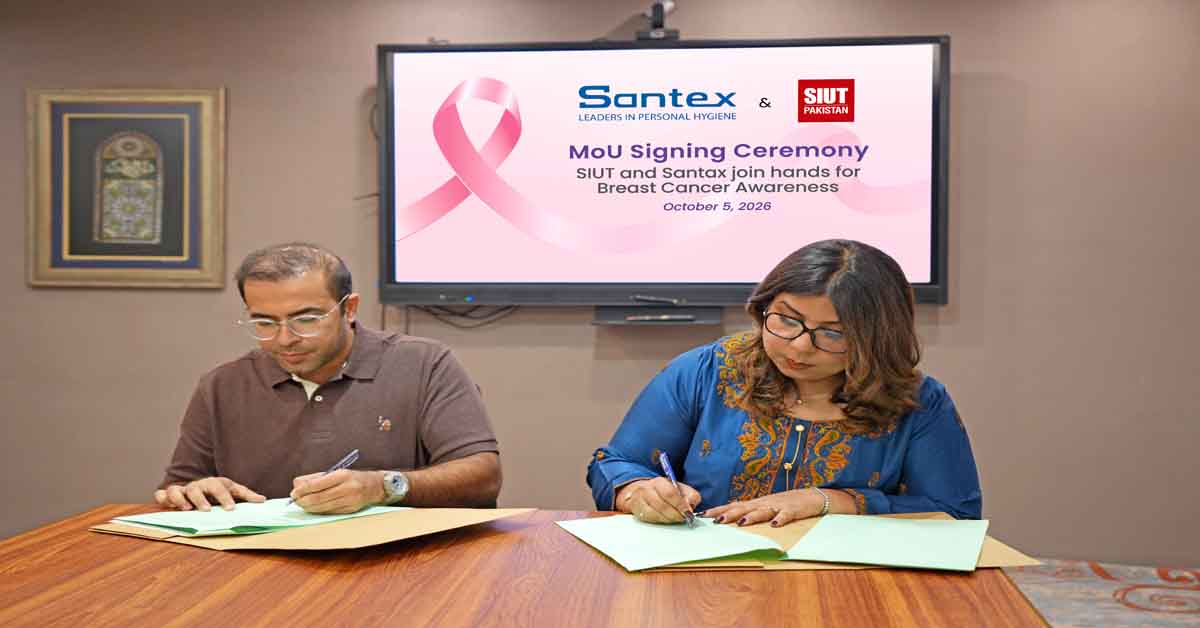
The MoU was signed by Dr. Lamiya Rizvi, Trustee, SIUT Trust, and Mr. Feroz Mujtaba Rahman, Director, Operations, Santex Products (Pvt.) Ltd. The initiative focuses on a straightforward message: women should have access to reliable information about breast health and know when to seek medical advice.

Taking Breast Health Information Beyond Hospitals
Breast cancer awareness depends not only on knowing that the disease exists, but also on understanding the value of paying attention to changes in the body. For many women, a clear explanation of breast self-examination can be a useful starting point for learning about breast health.
As part of the campaign, Santex will include breast cancer awareness inserts in its sanitary napkin packs. Each insert will feature a QR code linking to an educational video on breast self-examination developed by SIUT. Women can scan the code using a smartphone and watch the video to learn more about the self-check process.
This approach places health information in a setting that is already part of many women’s monthly routines. Rather than limiting the message to hospital visits, the campaign will give women another way to access educational material at a time and place that suits them.
The video will explain the importance of becoming familiar with one’s breasts and noticing changes that may need medical attention. In addition, the campaign encourages women to make breast self-examination part of their monthly routine, particularly 3–4 days after their menstrual cycle ends, in line with the timing specified in the campaign’s educational material.
Understanding Breast Self-Examination and Early Detection
Breast self-examination education encourages women to become familiar with the usual appearance and feel of their breasts. This familiarity may help them notice changes, such as a new lump, an unusual change in shape, skin changes, or changes around the nipple.
However, noticing a change does not automatically mean that a woman has breast cancer. Many breast changes can have other causes, which is why a medical assessment is important when something unusual appears or persists. Women should consult a qualified healthcare professional if they notice a new or concerning change rather than relying on self-examination alone.
It is also important to understand that breast self-examination is not a substitute for clinical assessment or recommended breast cancer screening. The campaign’s purpose is to provide basic health education and encourage women to seek professional advice when needed.
By explaining these points through an accessible video, SIUT aims to help women approach breast health with greater awareness and less uncertainty. Clear information can help women understand what to look for, when to raise a concern, and why medical advice should not be delayed when an unusual change is noticed.
SIUT’s Role in Public Health Education
SIUT is known for its commitment to providing free, quality healthcare with dignity to all. Alongside patient care, the institution’s participation in this campaign extends its health education work beyond the clinical setting.
Through the educational video, SIUT will provide the medical content that women can access through the QR code printed on the campaign inserts. The video gives the initiative a direct educational link to the institution, allowing women to access information prepared for the campaign rather than relying on unverified material circulating online.
Speaking on the occasion, Dr. Lamiya Rizvi, Trustee, SIUT Trust, said, “Our ambition to reach one million women reflects our commitment to taking credible health information beyond healthcare settings and into communities. Awareness and timely attention can play an important role in encouraging women to seek medical advice when needed.”
Her statement underlines the reason for taking health information into everyday settings: women should not have to wait for a healthcare appointment to begin learning about their health. Although educational material cannot replace a medical consultation, it can help women recognise when a concern needs professional attention.
Santex’s Work in Women’s Health and Menstrual Hygiene
Santex Products’ involvement in the campaign follows its wider work in women’s health, menstrual hygiene education, advocacy, and community outreach. Its activities have included efforts to improve access to menstrual hygiene products and help women and adolescent girls obtain information about menstrual health.
In 2022, Santex formalised a collaboration with UNICEF focused on addressing period poverty and improving access to safe, affordable menstrual hygiene products. Period poverty can affect access to essential products and make it harder for women and girls to manage menstruation with comfort and dignity. Access to products, however, is only one part of the issue; accurate information and open discussion are also needed.
Through school outreach programmes and workplace initiatives, Santex has promoted menstrual health awareness and worked to challenge the social stigma surrounding menstruation. These activities encourage conversations about a subject that can still be difficult for some women and girls to discuss openly.
The breast cancer awareness campaign adds another subject to this wider health education effort. While menstrual health and breast health are distinct topics, both benefit from access to reliable information and opportunities for women to ask questions without embarrassment. By placing educational material in sanitary napkin packs, the current initiative uses an existing distribution channel to share a separate and important message about breast health.
A Three-Month Campaign with a One-Million-Women Target
From October through December 2026, SIUT and Santex will work towards their target of reaching one million women with breast cancer awareness information. The campaign will use the awareness inserts and QR-linked SIUT video to communicate its message through Santex’s sanitary napkin packs.
The target represents the campaign’s intended reach, rather than a confirmed number of women already reached. Its success will depend on the distribution of the packs, women’s access to the inserts, and their engagement with the educational material.
For women who access the video, the central message is practical: learn about breast self-examination, pay attention to unusual changes, and seek advice from a qualified healthcare professional when necessary. The information is intended to support awareness, not to create fear or encourage women to diagnose themselves.
The partnership also demonstrates how healthcare institutions and private-sector organisations can use their respective resources to communicate public health information. SIUT contributes the educational content, while Santex provides a channel through which the message can reach women in their daily lives.
By extending breast cancer awareness beyond the hospital environment, the SIUT–Santex campaign aims to make reliable health information easier to access and encourage women to take informed steps towards caring for their breast health.
Disclaimer:
The information shared as part of this Breast Cancer Awareness Campaign is intended for educational purposes only. It is not a substitute for professional medical advice, diagnosis, or treatment. Breast self-examination can help women become familiar with their breasts and notice changes, but it does not replace clinical breast examination or recommended screening. If you notice any unusual changes, consult a qualified healthcare professional for proper assessment and guidance.