


Table of Contents
The carnivore diet is an animal-only eating plan. You eat meat, fish, eggs, and sometimes dairy. You skip every plant food — no vegetables, fruit, grains, nuts, or seeds. It’s zero-carb and high-fat, used mainly for weight loss and as an elimination protocol for digestive or autoimmune symptoms.
There’s no calorie math and no carb counting. You eat fatty animal foods until you’re full. That simplicity is the whole appeal — and also its biggest controversy.
This guide covers what to eat, what the research actually shows, how to start safely, and which variation fits your goals. Every claim below is checked against current clinical literature, not internet consensus.
What Exactly Is the Carnivore Diet?
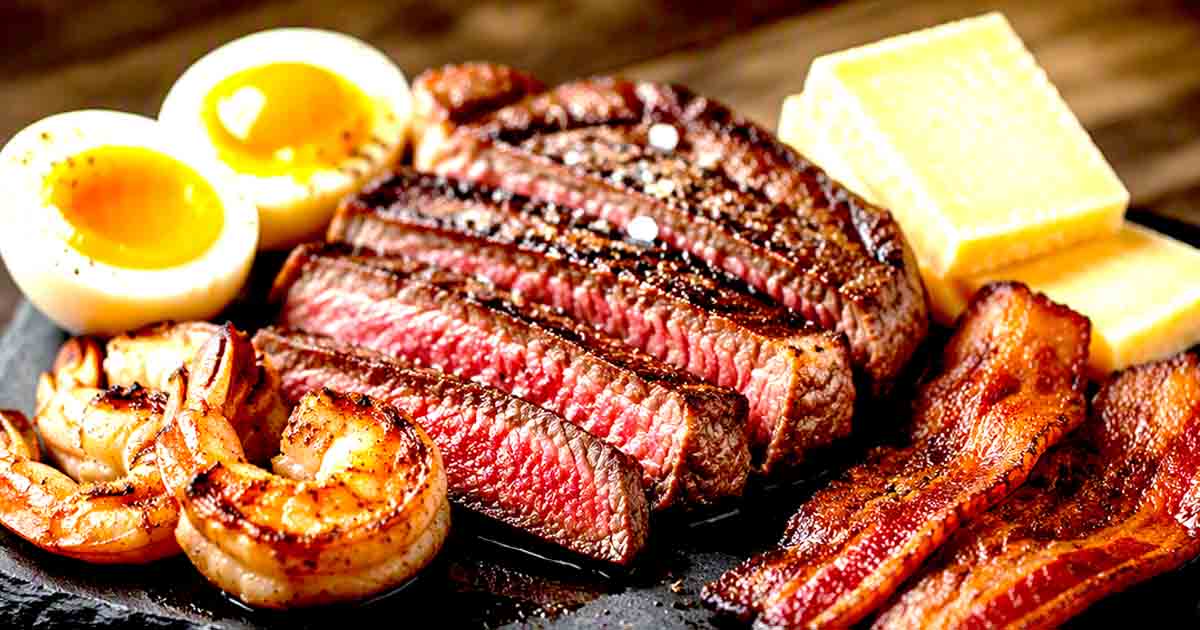
Picture a plate with grilled salmon, eggs, and a pat of butter — no vegetables, no fruit, no grains. That’s carnivore in one image.
It’s a meat-only diet that removes everything except animal products. Followers call the strictest version “strict carnivore”: meat, salt, and water, nothing else.
The pitch is simple. No more debating which vegetables are “healthy.” No tracking macros. You eat nutrient-dense animal foods your body recognizes, and you stop when you’re full.
Why Only Animal Products? The Philosophy
Carnivore eaters aim to remove common plant irritants — lectins, oxalates, fiber that can aggravate certain gut conditions — while leaning on nutrients animal foods deliver efficiently: vitamin B12, heme-iron, and complete, highly bioavailable protein.
This is also why the diet gets used clinically as an elimination protocol. Remove everything, let symptoms settle, then reintroduce foods one at a time to identify triggers. For a full breakdown of what’s on and off the plate, see the carnivore diet food list and the printable food list PDF.
The Three Levels: How Strict Should You Go?
Most people don’t jump straight to beef-only. A staged approach works better for adherence and gives your body time to adapt.
| Level | What’s Allowed | Best For |
|---|---|---|
| Beginner | All meat, poultry, fish, eggs, full-fat dairy, salt, coffee/tea | First-timers easing in |
| Advanced (Strict Carnivore) | Meat, fish, eggs, animal fats — no dairy, no processed meats | Testing dairy sensitivity |
| Lion Diet | Ruminant meat only (beef, lamb, bison), salt, water | Severe autoimmune or digestive symptoms |
The Lion Diet, popularized by Mikhaila and Jordan Peterson, is the most restrictive tier and is typically used as a short 30-to-90-day elimination phase rather than a permanent lifestyle. If dairy or non-ruminant meats seem to trigger symptoms on standard carnivore, this is the next step to isolate the cause.
Other named variations you’ll see referenced:
- All-Beef Diet — beef only, popularized by Jordan Peterson
- BBBE Diet — Beef, Butter, Bacon, and Eggs
- Animal-Based Diet — meat, organs, and occasional low-toxicity plant foods like honey or fruit; less strict than true carnivore
- Nose-to-Tail — organ meats prioritized for micronutrient density
- Ketovore — a middle ground between keto and carnivore that allows some low-carb vegetables; see the full ketovore diet guide, ketovore food list, and ketovore meal plan
For a direct side-by-side, see animal-based diet vs. carnivore diet.
What You Can and Can’t Eat
| Eat (Animal-Based) | Avoid (Everything Else) |
|---|---|
| Beef, pork, lamb, bison, venison | All vegetables |
| Poultry (chicken, turkey, duck) | All fruits |
| Fish and seafood | Grains |
| Eggs | Legumes |
| Animal fats (butter, tallow, lard) | Nuts and seeds |
| Optional dairy (hard cheese, full-fat yogurt) | Sugars, honey, syrups (debated — see below) |
| Salt and water | Plant oils |
| Bone broth | Alcohol, soda, most sweetened drinks |
Coffee and tea are genuinely debated in the community. Strict carnivores skip them since they’re plant-derived; flexible followers often keep black coffee. Milk on carnivore and raw honey on carnivore fall into similar gray areas — allowed by flexible or animal-based followers, excluded by strict practitioners. For the complete allowed-vs-not breakdown, see carnivore diet foods allowed or not.
How much to eat: Most practitioners eat to satisfaction rather than counting macros, but a rough starting point is 1–2 lbs of meat daily for women and 2–3 lbs for men, adjusted for activity level and body size. Fat matters as much as protein — undereating fat is the most common reason people feel exhausted in week one.
Choosing Quality Meat
Not all meat is equal for this diet:
- Grass-fed and pasture-raised beef carries a better omega-3-to-omega-6 ratio than grain-finished beef.
- Wild-caught fish avoids the additives sometimes found in farmed feed.
- Read labels on processed meats — bacon and sausage often hide added sugar, which technically breaks a strict carnivore protocol.
- For protein density by cut, see what meat has the most protein and the healthiest steak options.
What the Research Actually Shows
This is where most carnivore content online goes thin. Here’s what’s actually been published.
The most-cited data point is a 2021 survey published in Current Developments in Nutrition, which collected self-reported outcomes from 2,029 people following a carnivore diet for a median of 14 months. Participants reported a median BMI reduction from 27.2 to 24.3, and 95% reported an overall improvement in health. Reported adverse effects were mostly gastrointestinal — diarrhea and constipation topped the list. Because the data was self-reported and came largely through social media recruitment, it’s considered exploratory rather than conclusive (Lennerz et al., 2021).
The consistent, less debated finding: LDL cholesterol rises on this diet, often substantially. HDL and triglycerides frequently improve at the same time, which the carnivore community points to as reassuring — but the cardiology community generally still treats elevated LDL as an independent risk factor regardless of what else improves. For the full picture, see is red meat bad for cholesterol and why red meat isn’t automatically heart-healthy.
No major health or nutrition body currently endorses carnivore as a long-term eating pattern, largely because no long-term randomized controlled trials exist. Most current evidence comes from short surveys, case reports, and anecdote. That doesn’t mean it’s ineffective for the people it works for — it means the long-term safety data isn’t there yet, and anyone with existing kidney, liver, or cardiovascular conditions should treat this as a medically supervised experiment, not a default lifestyle.
Potential Benefits
Reported by many practitioners, though evidence quality varies:
- Weight loss — the high-fat, zero-carb structure tends to reduce appetite naturally
- Digestive relief — removing fiber and plant compounds can calm symptoms of IBS or SIBO for some people
- Reduced inflammation markers — commonly self-reported, less consistently measured in research
- Mental clarity — steady blood sugar with no post-carb crash
- Skin and energy — frequently reported, though placebo and elimination-diet effects can’t be ruled out
Potential Risks
- LDL cholesterol elevation — the most consistent finding across available data
- Nutrient gaps — vitamin C and fiber are the two most commonly flagged shortfalls without organ meats or supplementation
- Kidney strain — a concern specifically for people with pre-existing kidney disease
- Social friction — eating out and shared meals get harder
- Unknown long-term safety — data beyond 1–2 years of adherence is essentially nonexistent
Always loop in a doctor before starting, especially with any existing heart, kidney, or metabolic condition. If you want a sense of what practitioners actually track over time, see the 30-day carnivore diet results and before-and-after outcomes.
Who Doctors on the Diet Actually Say
A handful of physicians have built public followings promoting or researching carnivore eating, with mixed and sometimes contested track records. For a rundown of the most-cited names, see 7 top carnivore diet doctors.
One especially discussed case: Paul Saladino, MD, built a large following advocating a strict animal-based approach, then later publicly reversed course and reintroduced fruit and honey — a shift that drew significant pushback from the community. See Paul Saladino’s controversies and why he says he quit strict carnivore for the full story, plus a broader fact-check of common carnivore claims.
Getting Started: Your First Week
- Check with a doctor first. This matters most if you have any existing health condition — get baseline bloodwork before you start, so you have something to compare against later.
- Clear out plant foods. Bread, rice, snacks — out of the pantry, so willpower isn’t doing all the work.
- Define your goal. Weight loss, gut symptoms, and autoimmune relief call for slightly different approaches and timelines.
- Plan simple meals. Steak, ground beef, and eggs are the easiest entry point — see easy carnivore diet recipes and breakfast ideas to start.
- Track a baseline. Weight, energy, mood, and any symptoms on day one — the changes are easy to miss without a starting point.
Sample First-Week Day
- Breakfast: Two fried eggs with steak
- Lunch: Ground beef patties with salt
- Dinner: Ribeye steak
- Snacks: Hard-boiled eggs or beef jerky
For a full structured plan beyond week one, see the complete carnivore diet meal plan and lunch ideas.
Hydration and Electrolytes
Zero-carb eating flushes water and sodium faster than a typical diet. Aim for 2–3 liters of water daily, and add 1–2 tsp of salt to meals to offset losses. Magnesium supplementation helps if cramping shows up; check with a doctor before adding it. See the full carnivore drink list for what’s allowed beyond water.
Adjusting as You Go
Fatigue in week one usually means you’re under-eating fat, not protein — aim closer to 70% fat, 30% protein if energy dips. If nausea or symptoms worsen after a month rather than improving, that’s a signal to reassess with a nutritionist rather than push through.
How Long Should You Try It?
A 30-day trial is the standard starting point — long enough to move past the adaptation phase (roughly days 7–14) and see whether symptoms genuinely improve. Some people stay on it for months or years with regular bloodwork; others use it strictly as a diagnostic tool before reintroducing select plant foods.
Carnivore-Specific Guides
- Carnivore diet for women and a dedicated women’s carnivore diet plan
- Carnivore diet before-and-after results at 30, 60, and 90 days
- Carnivore on a budget
- Carnivore diet for weight loss
Frequently Asked Questions
What can you eat on the carnivore diet?
Meat, fish, eggs, and — for most people — full-fat dairy. Beef, pork, chicken, lamb, salmon, eggs, and butter form the core of most meal plans.
Is the carnivore diet healthy?
It may help with short-term weight loss and some digestive symptoms, but it consistently raises LDL cholesterol and lacks fiber and vitamin C. Long-term safety data doesn’t yet exist. Talk to a doctor before starting.
Does the carnivore diet raise cholesterol?
Yes — this is the most consistent finding in current research. LDL rises in nearly every study measured, though HDL often improves alongside it. Whether that trade-off matters for your specific risk profile is a conversation for your doctor, not a blog post.
What’s the difference between the Lion Diet and standard carnivore?
The Lion Diet only allows ruminant meat (beef, lamb, bison), salt, and water. Standard carnivore also allows poultry, fish, eggs, and dairy. The Lion Diet is typically a short elimination phase, not a permanent plan.
How long does it take to see results?
Most people notice changes in energy and digestion within the first two weeks, once initial adaptation symptoms pass. Weight loss often continues gradually through the first month.
Can I drink coffee on carnivore?
It’s debated. Strict carnivores skip it since it’s plant-derived; flexible followers often keep black coffee. There’s no strong evidence either way for most people.
References:
-
Behavioral Characteristics and Self-Reported Health Status among 2,029 Adults Consuming a “Carnivore Diet” — PubMed, 2021
https://pubmed.ncbi.nlm.nih.gov/34934897/
(Note: The PubMed entry links to the article in Current Developments in Nutrition.) -
Carnivore diet – a rare cause for dyslipidemia mimicking homozygous FH — Atherosclerosis, 2022
https://www.atherosclerosis-journal.com/article/S0021-9150(22)00975-3/fulltext -
Comparative Effects of Carnivore and Mediterranean-style Diets on LDL Aggregation and Cardiometabolic Health — active clinical trial, Liverpool John Moores University
https://clinicaltrials.gov/study/NCT07462871 -
Ketogenic and Carnivore (Lion) Diets for Inflammatory Bowel Disease and Rheumatoid Arthritis — active clinical trial, Fuller Research Foundation, 2026
https://clinicaltrials.gov/study/NCT07524244 -
Is the Carnivore Diet Bad for Cholesterol? — Medical News Today
https://www.medicalnewstoday.com/articles/is-the-carnivore-diet-bad-for-cholesterol -
Is the Carnivore Diet Healthy? — News-Medical
https://www.news-medical.net/health/The-Carnivore-Diet-Healthy-Trend-or-Risky-Fad.aspx
This article is for informational purposes only and isn’t medical advice. It doesn’t replace guidance from a qualified healthcare provider. Individual needs vary — talk to your doctor before making significant dietary changes, especially if you have an existing health condition.